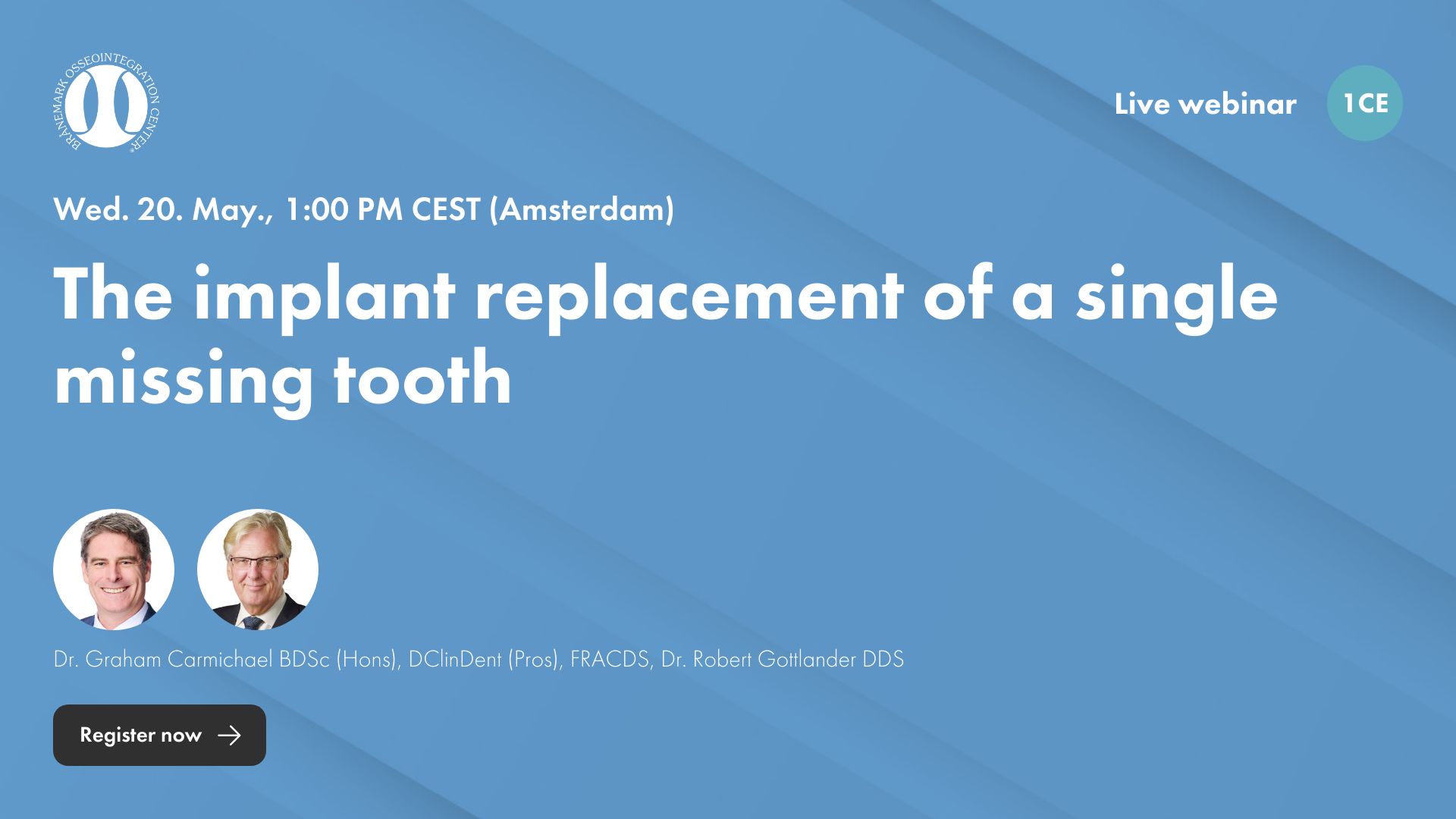
This webinar explores clinical workflows for single tooth implant replacement in the anterior maxilla, focusing on treatment planning, surgical and prosthetic considerations, and evidence-based decision-making to achieve predictable functional and aesthetic outcomes.
The implant replacement of a single missing tooth has a long history of clinical success and can provide a functional and aesthetic outcome in what can be a challenging situation for a patient. Being a freestanding solution that doesn’t
involve preparation of the adjacent teeth, the implant replacement can be restoratively conservative, and by being fixed, avoid the inconvenience or embarrassment of frequent prosthetic tooth removal.
In the anterior maxilla and what is considered the primary aesthetic zone, the single implant replacement may however be one of the most technically challenging solutions, and one which has numerous clinical workflows from preliminary tooth
extraction and delayed implant placement into a healed site, to the immediate placement at time of extraction with immediate loading, each option with its indications and advantages in certain clinical situations.
Whilst the patient expectation or pressure to not be without a tooth especially in the aesthetic zone might drive treatment, the treatment provided should ideally follow an evidence based protocol. The clinician must make a decision on what is the most appropriate and predictable treatment modality to achieve a predictable outcome, and an increasing volume of evidence now assists in treatment decisions. Unfortunately no single protocol applies to all situations, and operator and patient mediated factors will still influence the outcome, with every patient and deserving an individual approach.
The replacement of a single tooth is not just reliant on the surgical process and the restorative decisions will also significantly impact on the outcome for the patient.
How is the implant position registered for the laboratory fabrication? What materials are used and what influence this has on the implant and adjacent soft tissues? Is the restoration cemented onto an abutment, or is the abutment crown
purely screw retained improving retrievability and avoiding any possibility of retained cement?
This webinar will outline a variety of workflows to provide a clinician with information to assist in decision making to achieve a predictable and successful outcome for the replacement of a single missing tooth with a dental implant from
a surgical and prosthetic perspective, and with considerations of the long term maintenance that is essential as part of the treatment.
Learning Objectives
1. Understand how a single tooth can be replaced with a dental implant
2. Awareness of the different workflows of treatment
3. Understand what materials should be used are optimal and why
4. Factors affecting the long term prognosis of treatment




 Tribune Group GmbH Inc.